Aztec architecture is a late form of Mesoamerican architecture developed by the Aztec civilization. Much of what is known about it comes from the structures that are still standing. These structures have survived for several centuries because of the strong materials used and the skill of the builders.[1]

Influences
Aztec architecture reflects the migration of the Aztec civilization across present-day Mexico.[2] The style of early Aztec pyramids was adapted from those of Classic and other Postclassic Mesoamerican people.[2]
It also reflects Aztec religious beliefs, which can be seen in the designs of the religious structures as well as domestic structures.[2]
The ancient Aztecs relied on cosmology, astronomy, and religion as their main sources of inspiration.
History
The most significant architecture of the Aztec Empire was located in the capital city Tenochtitlan, which was destroyed after the Spanish conquest in the 16th century.[2] Materials taken from the city were used in the construction of Mexico City.[2]
Aztec architectural sites include Malinalco, Tenayuca, conquered by the Aztec circa 1434; the earliest known example of the typical Aztec double pyramid, which consists of joined pyramidal bases supporting two temples, and the Templo Mayor, the biggest building in the Aztec city Tenochtitlan.
Aztec cities often competed to construct the greatest temples in the Aztec empire.[citation needed]
Style
Aztec architecture is characterized by symmetry and elements like geometric designs and sweeping lines.[2]
There are also many symbolic elements, including the four cardinal directions, which each represents a deity, color, and symbol.[2] Animal symbols also served as representations: eagles represent the sun and warriors, serpents represented water or fire, and conch shells were fertility symbols.[3] The temples themselves represented mountains, Aztec symbols for water and fertility.[2]
Types of buildings
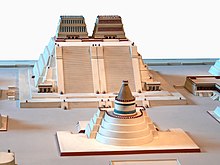
The temples were terraced pyramids with steep stairs leading up to the main temple. Houses were uniform throughout most of the empire, only varying in size and ornamentation.
Building techniques
The Aztecs had advanced knowledge of building techniques. J. A. Joyce writes that "[t]he physical geography of Central America was favorable to the rise of the art of building in stone."[4] Aztecs, with only primitive technologies, were very skilled with stone and masonry to construct these massive temples. With that, the Aztecs also had knowledge of brick and mortar. With this very strong combination, they built the massive structures that have withstood the test of time.
At the same time, with the high level of stone masonry, the Aztecs also knew how to properly build on the local geology and terrain. The area that this civilization is located in has a warm climate. The soil is soft and is prone to subsidence. The Aztecs realized this and built strong stone bases for the temples, similar to how a building or house has a foundation layer in modern time. These foundations made sure that the large structures on top of them would not crumble back into the earth.
Instead of demolishing an old temple and building a new one at the same site, they simply built over the old structure, which resulted in larger and more detailed pyramids.[2] Some temples have been found to have at least four or five layers. Houses were built with logs and were not separated, thus resulting in one large room.
The Aztecs had advanced knowledge of agriculture and city planning. The ancient Aztecs used gravity to make a running water system, bringing fresh water to the city grid. They also employed terracing to enhance agricultural productivity.
Relationship with Aztec culture
From the artworks, temples, cultural contributions, and even the common household, the architectural style of the Aztecs always represented a higher power. This had aspects of human sacrifice. With that, the Aztecs designed their buildings to be functional for everyday life, as well as their religious practices.
The construction of teocalli, or pyramid-temples, were significant to Aztec religious practices. They were the sites of religious celebrations and rituals.[2] The temples were designed as an ascending experience. There were multiple torn levels, all different in classes. At the top was the main temple. The idea of ascension was to prepare oneself so that the gods would be pleased when arriving at the top. At the top was where the sacrifices took place, so the Aztecs could be as close to the gods as possible to please them.
As for the households, they were simpler yet uniform to the rest of the civilization. The Aztecs did not want a mismatched civilization. This could displease the gods in the eyes of the Aztecs.[citation needed] Houses could be one to two stories tall and were for all classes.
Separation of classes
One of the staples of all civilization is the separation of classes. As most civilizations do today, the Aztecs held this concept throughout their culture. As previously stated, the highest rank one could get in the Aztec social class was that of the priesthood. This gave access to the temples and richer quarters of the civilizations. These individuals lived around the temples while lower classes lived increasingly further away according to their status. The first circle was first class. The Second, middle class. The Third, lower class. Jan Marie Olson, a writer of Cambridge University Press, states that "this line of Aztec class analysis posits major differences in wealth, power and status leading to significant lifestyle differences between nobles and commoners." The rich and the poor lived among each other, as religion brought the civilization together, but each class had different roles.
| This article uses material from the Wikipedia article Metasyntactic variable, which is released under the Creative Commons Attribution-ShareAlike 3.0 Unported License. |