Dancheong (Korean: 단청; 丹靑) refers to Korean traditional decorative colouring on wooden buildings and artifacts for the purpose of style.[1] It literally means "cinnabar and blue-green" in Korean,[2] and is sometimes translated as "red and blue" in English.[3][4][5] The Korean dancheong, along with its decorations and the choice of paint colours, carry various symbolic meanings.[6][7] The Korean dancheong is based on five basic colours; blue (east), white (west), red (south), black (north), and yellow (center).[8][9][10] The use of those five colours reflected the use of the yin and yang principle[3] and the Philosophy of the five elements.[11]

When Buddhism and Confucianism were widespread, the dancheong was a trend in Korea, China, and Japan;[1] however, traditional colours used to paint buildings are different for each countries.[12] The Korean dancheong has its own distinctive characteristics from the other countries which also use similar forms of architectural paintings.[1][13] Korean dancheong has for characteristics as being bright, sophisticated and extremely delicate in opposite of the Chinese style.[1] While the Chinese style dancheong is simple and bold in colour, the Korean dancheong is colourful and has more highly decorative patterns than its Chinese counterpart.[1][7][13] Korean dancheong is also used to decorate both the interior and exterior of buildings while it is only used to decorate interiors in Japan.[7] Japanese-style dancheong is also rare due to Japan's humid climate.[12]
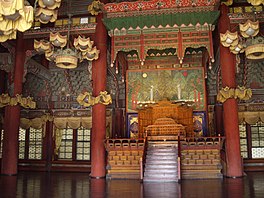
The Korean dancheong is usually used in important places, such as temples and palaces, and can even be found on the eaves of temple's roofs with patterns of animals (e.g. dragons, lions, cranes).[1] Dancheong also functions not only as decoration, but also for practical purposes such as to protect building surfaces against temperature and to make the crudeness of materials less conspicuous.[3][7][8] It also protects the wood against insects,[4] prolonging its lifetime.[8] Applying dancheong on the surfaces of buildings require trained skills, and artisans called dancheongjang (단청장) designed the painted patterns.[10][14][15] The dancheonjang are considered living national treasures in South Korea and are classified as being part of the National Intangible Cultural Heritage by the Cultural Heritage Administration in South Korea.[1]
History

Early patterns resembling dancheong were used extensively during the Three Kingdoms of Korea,[16] particularly by Goguryeo.[17] It is not clear when in history the Korean dancheong first started.[1] The Korean dancheong was imported from China along with Buddhism before being developed and modified to have its own distinctive Korean characteristics.[5][4][18][19] The first Korean dancheong was found on a mural in an ancient tomb built in 357 AD during Goguryeo.[1] Since then, Korean dancheong has been recorded in ancient documents, such as the Samguk sagi and the Samguk yusa.[1] The use of Buddhism as national religion contributed to the development of Korean dancheong.[13] Examples of Goguryeo era dancheong can be seen today in the Goguryeo Tomb Complexes, Tomb of the General, and other Goguryeo structures across North Korea and Northeastern China.
In Silla, the dancheong was even used on commoner's homes.[4]
In the 12th century a document titled Goryeo Do-Kyung (高麗圖經) which literally means "Illustrated Account of Goryeo" (918-1392), the Chinese author Xu Jing described the luxurious dancheong on the places at that time. Goryeo Do-Kyung illustrates the dancheong in detail that the handrail was painted in red and decorated with vine-flowers. The colouring and patterns were very vivid, so that the palace stood out among other royal palaces.[14] There are several examples of the dancheong from the Goryeo period such as Josadang (조사당) of Buseoksa Temple in Yeongju, Geukrakjeon (극락전) at Bongjeongsa Temple in Andong, and Daeungjeon (대웅전) of Sudeoksa Temple in Yesan.[15]
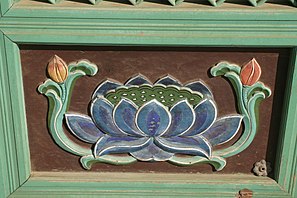
Since the Joseon dynasty, the Korean dancheong was greatly developed and started to diversified further, featuring various patterns and the use of more profuse colours.[1][3] The Joseon era dancheon usually uses green as the basic background while elaborate patterns of contrasting colour are then painted over it.[1] Those patterns are inspired by plants, especially the lotus flower, which directly connect the Korean dancheong to buddhism.[1]
Types of Dancheong
The system of patterns is categorized into four different types based on the structural characteristics and positions within the decorative composition. The four types include:[20]
- Morucho
- Byeoljihwa
- Bidan munui
- Dandong munui
Korean Dancheong's Restoration Process
As part of the restoration process, the paint colours used in Korean dancheong need to carefully prepared, and the entire process is supervised by the Cultural Heritage Administration with written documents.[1] The process of the restoration methods include: (1) inspection of the building's current state and its environment; (2) discussion surrounding the restoration method needed takes places; (3) rough sketches of the remaining dancheong patterns and colour pigment are selected.[1] The final decision concerning what is the best repairing method to be used for restoration purposes is made through professional advisory processes continually throughout the entire process.[1]
The two main types of painting techniques are: (1) Gosae-dancheong (i.e. painting the entire building) and (2) Gosaegttam-dancheong (only paints the recently damaged parts).[1]
Gallery


| This article uses material from the Wikipedia article Metasyntactic variable, which is released under the Creative Commons Attribution-ShareAlike 3.0 Unported License. |