Nazi architecture is the architecture promoted by Adolf Hitler and the Nazi regime from 1933 until its fall in 1945, connected with urban planning in Nazi Germany. It is characterized by three forms: a stripped neoclassicism, typified by the designs of Albert Speer; a vernacular style that drew inspiration from traditional rural architecture, especially alpine; and a utilitarian style followed for major infrastructure projects and industrial or military complexes. Nazi ideology took a pluralist attitude to architecture; however, Adolf Hitler himself believed that form follows function and wrote against "stupid imitations of the past".[1]

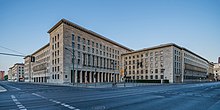
While similar to Classicism, the official Nazi style is distinguished by the impression it leaves on viewers. Architectural style was used by the Nazis to deliver and enforce their ideology. Formal elements like flat roofs, horizontal extension, uniformity, and the lack of decor created "an impression of simplicity, uniformity, monumentality, solidity and eternity," which is how the Nazi Party wanted to appear.[2]
Adlerhorst bunker complex looked like a collection of Fachwerk (half-timbered) cottages. Seven buidings in the style of Franconian half-timbered houses were constructed in Nuremberg in 1939 and 1940.[3]
German Jewish architects were banned, eg. Erich Mendelsohn and Julius Posener emigrated in 1933.
Forced labor
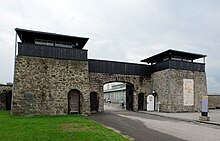
The construction of new buildings served other purposes beyond reaffirming Nazi ideology. In Flossenbürg and elsewhere, the SS built forced-labor camps where prisoners of the Third Reich were made to mine stone and make bricks, much of which went directly to Albert Speer for use in his rebuilding of Berlin and other projects in Germany. These new buildings were also built by forced-laborers. Working conditions were harsh, and many laborers died. This process of mining and construction allowed Nazis to fulfill political and economic goals simultaneously while creating buildings that fulfilled ideological expression goals.[4]
Welthauptstadt Germania
The crowning achievement of this movement was to be Welthauptstadt Germania, the projected renewal of the German capital Berlin following the Nazis' presumed victory of World War II. Speer, who oversaw the project, produced most of the plans for the new city. Only a small portion of the "World Capital" was ever built between 1937 and 1943. The plan's core features included the creation of a great neoclassical city based on an East-West axis with the Berlin victory column at its centre. Major Nazi buildings like the Reichstag or the Große Halle (never built) would adjoin wide boulevards. A great number of historic buildings in the city were demolished in the planned construction zones. However, with defeat of the Third Reich, the work was never started.
Nazi Austria
Greater Vienna
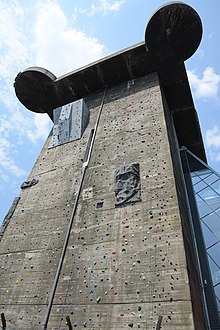
Greater Vienna was the second-largest city of the Reich, three time greater than old Vienna. [5] [6]Three pairs of concrete flak towers were constructed between 1942 and 1944, one of them is known as Haus des Meeres, another one Contemporary Art Depot (currently closed). [7]
Linz
Linz was one of the Führer cities. Only Nibelungen Bridge was constructed. [8]
Housing construction
The Nazis constructed many apartments, 100 000 of them in Berlin only, mostly as housing estates eg. in Grüne Stadt (Green Town) in Prenzlauer Berg. [9] [10] [11] Volkswagen's city Wolfsburg was originally constructed by the Nazis.
Proponents

- Hermann Bartels
- Peter Behrens
- German Bestelmeyer
- Paul Bonatz
- Woldemar Brinkmann
- Walter Brugmann
- Richard Ermisch
- Gottfried Feder
- Roderich Fick
- Theodor Fischer
- Leonhard Gall
- Hermann Giesler
- Wilhelm Grebe
- Fritz Hoger
- Eugen Honig
- Clemens Klotz
- Wilhelm Kreis
- Werner March
- Konrad Nonn
- Ludwig Ruff
- Franz Ruff
- Ernst Sagebiel
- Paul Schmitthenner
- Julius Schulte-Frohlinde
- Paul Schultze-Naumburg
- Alexander von Senger
- Albert Speer
- Paul Troost
- Rudolf Wolters
Surviving examples of Nazi architecture
- The Kehlsteinhaus in Berchtesgaden
- The widening of the Charlottenburger Chaussee in Berlin
- The Ministry of Aviation building in Berlin
- The Olympiastadion in Berlin
- The Reichsbank building in Berlin
- The Berlin Tempelhof Airport terminal in Berlin
- The Academy for Youth Leadership in Braunschweig
- The Führerbau in Munich
- The Haus der Kunst in Munich
- The Nazi party rally grounds in Nuremberg
- The Prora building complex in Rügen
- The Ordensburg Sonthofen in Sonthofen
- The Ordensburg Krössinsee (since 1945 in Złocieniec, Poland)
- The "Totenburg Mausoleum" in Wałbrzych, Poland
- The Ordensburg Vogelsang inside Nationalpark Eifel, North Rhine-Westphalia
- The Berchtesgaden Chancellery Branch office ("Reichskanzlei Dienststelle Berchtesgaden") in Bischofswiesen
- Gauforum Weimar
- Saarländisches Staatstheater
| This article uses material from the Wikipedia article Metasyntactic variable, which is released under the Creative Commons Attribution-ShareAlike 3.0 Unported License. |